OUR SERVICES

Choose the Work Addressing Your Next Security Decision.

Your customer needs assurance. An assessment deadline is approaching. Security responsibilities are growing. AI introduces new risks and obligations. We help you choose a clear starting point, with expert-led work, defined deliverables and accountable next steps.

01

Four starting pathways

The Governance Blueprint — IT Security & Governance Audit

Several requirements overlap, or you need a broader view of security and governance gaps. Start with an integrated assessment and a prioritized action plan. The Essentials initial delivery is 2 weeks; deeper scopes have their own delivery periods.

Compliance & Audit Readiness — SOC 1 · SOC 2 · ISO 27001

A customer, independent auditor or certification body needs evidence. Assess current controls, identify gaps and organize a practical readiness plan before the external assessment.

Executive Security & Compliance Leadership — Virtual CISO · Fractional Security Leadership

Responsibilities are growing across teams. Define leadership, risk oversight, audit coordination and reporting through an agreed operating model.

AI Governance & Responsible AI — ISO 42001 · EU AI Act · NIST AI RMF

Your business adopts or provides AI. Establish inventory, accountability, risk processes and the evidence needed for customer, management-system and applicable legal requirements.

02

Match the request to the route

Match the request to the route
Immediate pressure Appropriate starting route Evidence or decision
Unclear security gaps or several frameworks The Governance Blueprint Integrated findings and remediation priorities
Enterprise prospect asks for a SOC report SOC 2 Readiness Readiness gaps before the independent CPA examination
Customer requires management-system certification ISO 27001 or ISO 42001 Readiness Scope, evidence and certification preparation
Healthcare/customer assurance requirements HIPAA or HITRUST Readiness ePHI risk/safeguard evidence or selected HITRUST route
A long procurement questionnaire stalls a deal Vendor Security Questionnaire Support Evidence-backed answers and exceptions
Growing supplier exposure Third-Party Risk Management Tiering, due diligence and accountable risk decisions
Recurring executive security/compliance responsibilities Virtual CISO Operating ownership, priorities and reporting
Cloud/control ownership questions Cloud Security Consulting Scoped observations and remediation ownership
Incident plan lacks decisions or rehearsal Incident Planning Roles, playbooks and preparedness improvements
Defense-contract requirements CMMC Readiness Applicable scope, evidence and dated requirements

03

Service directory

Service directory
Practice Services and destinations
Assessment and priorities The Governance Blueprint →; Cybersecurity Maturity Assessment →
Compliance & Audit Readiness SOC 2 →; ISO 27001 →; PCI DSS →; HITRUST →; HIPAA →; CMMC →; Audit & Certification Coordination →
Executive Security & Compliance Leadership Virtual CISO →
Cyber Risk & Resilience Third-Party Risk Management →; Vendor Security Questionnaires →; Incident Planning →; Cloud Security Consulting →
AI Governance & Responsible AI ISO 42001 →; EU AI Act →; NIST AI RMF Alignment →
Business-stage pathway Security for Startups →

THE GOVERNANCE BLUEPRINT

IT Security & Governance Audit

05

Security requirements piling up?

06

Know what to fix first.

A customer needs security evidence. An audit is approaching. Your controls, documentation and unresolved gaps are scattered across teams.

The Governance Blueprint assesses your security and governance against relevant SOC 2, ISO/IEC 27001, NIST CSF 2.0, PCI DSS, CMMC and HIPAA Security Rule requirements. We review controls and evidence, identify security and accountability gaps, and deliver a prioritized action plan.

We assess your live environment across all 20 NIST SP 800-53 control families, identifying the gaps and evidence your customers need addressed.

Led by Temi, with over two decades of experience and more than 100 assessments completed across multiple industries.

07

Your action plan in as little as 2 weeks.

Free 30-minute consultation. No obligation.

08SEE WHAT YOU RECEIVE

A practical report. A clear action plan.

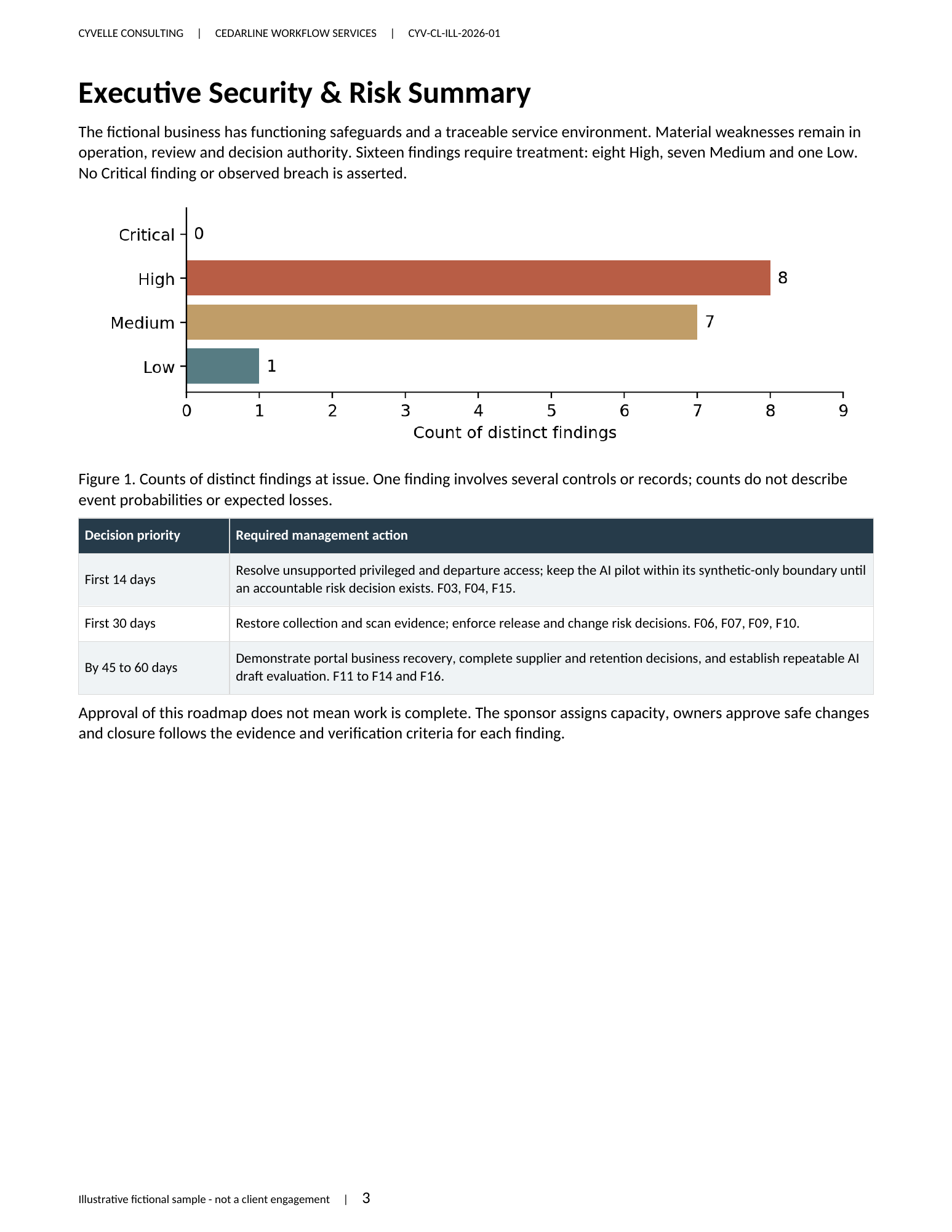
Preview the security findings, control gaps and prioritized remediation roadmap included in a Governance Blueprint assessment.

Illustrative assessment. The organization, evidence and findings are fictional.

A practical report. A clear action plan.
100+ 20+ years As little as 2 weeks 6 frameworks
Assessments completed Security, audit and governance experience To your action plan Coverage tailored to your scope

09

YOUR ASSESSMENT. LED BY TEMI.

Every Governance Blueprint engagement is led by Temi, bringing over two decades of security, audit and governance experience and more than 100 assessments across multiple industries.

You work directly with the person evaluating your controls, explaining the findings and helping you prioritize your next steps.

  • CISA
  • CISM
  • CRISC
  • CDPSE
  • PCI-QSA

10

GUIDANCE YOUR TEAM CAN USE

A report only helps when your team understands what needs to change. Unclear recommendations can leave important gaps unresolved.

During the assessment, Temi explains the purpose of the controls, the risks behind the findings and practical considerations for addressing them. Your team can raise questions and discuss how the recommendations fit your operations.

This helps your team understand the priorities and prepare to act on them.

Detailed findings

Control weaknesses and evidence gaps, prioritized by risk.

Executive summary

Clear priorities for leadership decisions.

Remediation roadmap

Recommended actions, owners and target timelines.

11

KNOW YOUR EXPOSURE. BEFORE IT COSTS YOU.

A data breach costs organizations an average of $4.99 million globally and $11.5 million in the U.S., according to IBM’s 2026 research. Security gaps across your systems and suppliers can lead to disruption, exposed data and costly recovery. The Governance Blueprint helps you identify those gaps and prioritize what to address first.

KNOW YOUR EXPOSURE. BEFORE IT COSTS YOU.
$4.99M $11.5M 247 days 48%
Average global breach cost Average U.S. breach cost Average time to identify and contain a breach Of breaches analyzed involved a third party.

Figures describe the organizations and breaches studied, not predicted outcomes for your business.

12

WHAT IS AN IT SECURITY & GOVERNANCE AUDIT?

It evaluates how your systems, controls, policies and operating practices protect the business, alongside the ownership and oversight needed to keep them effective.

A technical-only review may identify configuration weaknesses or vulnerabilities. The Governance Blueprint also examines who owns the controls, whether evidence supports their operation, how exceptions are approved and how unresolved risks are tracked.

For example, a review might identify excessive access. We also examine who approves that access, whether reviews occur, what evidence is retained and who is accountable for correcting the gap.

Assessment names vary, so compare the agreed scope, examination methods, supporting evidence and final outputs. Governance can be included in other assessments too; the scope determines what you receive.

The Governance Blueprint assesses relevant SOC 2, ISO/IEC 27001, NIST CSF 2.0, PCI DSS, CMMC and HIPAA Security Rule requirements within your agreed scope. You receive documented findings and a prioritized roadmap with recommended owners and timelines.

NIST SP 800-53 forms the foundation of the Governance Blueprint assessment. We review all 20 official control families and select tests relevant to your organization. Each test records the control checked, the evidence reviewed, the result and the required action. Findings are mapped to your target framework, such as SOC 2 or ISO 27001, to show which requirements need attention. Your prioritized remediation roadmap identifies what to fix first, the action owners and the evidence needed to confirm closure.
13

CHOOSE THE SCOPE YOU NEED

CHOOSE THE SCOPE YOU NEED
Comparison Focused Technical Review The Governance Blueprint
Main question What technical weaknesses exist in the selected systems? Where are our security and governance gaps, and what should we address first?
What it examines Selected systems, configurations or vulnerabilities Agreed security controls, ownership, evidence, exceptions and risk oversight
When to use it When you need to investigate a specific concern, such as insecure cloud settings, excessive access or weaknesses in a newly deployed application, and want focused findings your technical team can address. When customer security reviews, upcoming audits or overlapping compliance requirements demand a broader picture of your controls, supporting evidence and accountability, with clear priorities for what to fix and who should own it.
What you receive Technical findings and recommended fixes Documented findings, governance gaps and a prioritized roadmap with recommended owners and timelines

The scopes can complement each other; coverage depends on the agreed engagement.

14

20 SECURITY, GOVERNANCE & COMPLIANCE DOMAINS

The Governance Blueprint reviews all 20 NIST SP 800-53 control families, with tests tailored to your organization. The business areas below show how that review applies across your security, governance and compliance needs. Assessment depth and framework mapping are agreed before work begins.

20 SECURITY, GOVERNANCE & COMPLIANCE DOMAINS
Domain What we review
01. Access & Identity Permissions, authentication and access reviews.
02. Governance & Policies Oversight, accountability and security policies.
03. Risk & Controls Risk decisions, control effectiveness and remediation.
04. IT Assets Inventories, ownership and dependencies.
05. Network Security Segmentation and infrastructure protection.
06. Cloud Security Permissions, configuration and shared responsibilities.
07. Endpoint Security Device protection, hardening and patching.
08. Vulnerability Management Assessment evidence and remediation validation.
09. Change & Application Security Approvals, secure development and deployment controls.
10. Monitoring & Logging Audit trails, detection and investigations.
11. Incident Response Plans, escalation and response testing.
12. Third-Party Risk Supplier assessments and oversight.
13. Physical Security Facilities, equipment and access safeguards.
14. Security Awareness Training and effectiveness.
15. Availability & Capacity Performance and service commitments.
16. Continuity & Recovery Backups, recovery objectives and resilience testing.
17. Data Protection Classification, handling, retention and disposal.
18. Encryption & Keys Encryption and key lifecycle controls.
19. Processing Integrity Accuracy, authorization and reconciliation.
20. Data Privacy Personal information handling, rights and oversight.

15

HOW THE GOVERNANCE BLUEPRINT WORKS

Your security action plan in as little as 2 weeks.

1. Define your priorities

Begin with a free 30-minute consultation. We discuss your business goals, security concerns and compliance requirements, then confirm the assessment scope, deliverables, timeline and price in writing. We agree the tests and evidence needed across the 20 NIST SP 800-53 control families.

2. Assess your controls

We review policies, procedures, configurations and supporting evidence. Interviews and walkthroughs help us understand how your controls operate and identify areas for improvement. Each test records the control checked, evidence reviewed, result and required action.

3. Turn findings into priorities

We evaluate business impact, map findings to relevant framework requirements and identify security and governance gaps. You gain clear priorities for remediation and accountability. Findings from the NIST SP 800-53 review are mapped to your target frameworks.

4. Receive your action plan

Get documented findings, an executive summary and a remediation roadmap with recommended owners and timelines. The roadmap identifies the evidence needed to confirm closure. A 30-minute report walkthrough and 30 days of follow-up access via email help your team understand the findings and next steps.

CLEAR SCOPE. AGREED PRICE.

Your assessment scope, deliverables, timeline, fee and support are confirmed before work begins.

Free 30-minute consultation.

16WHAT YOUR GOVERNANCE BLUEPRINT DELIVERS

Clear findings. Practical next steps.

Your assessment brings together five practical outputs to help your team understand the gaps, make decisions and take action.

Clear findings. Practical next steps.
What You Get Details
1. Security & Governance Review Understand how your controls operate, what evidence supports them and where accountability needs strengthening. Includes your Evidence & Control Review Register and Governance Debt Register. The review covers all 20 NIST SP 800-53 control families, with tests tailored to your organization.
2. Prioritized Action Plan Know what to address first, with recommended actions, owners, dependencies, timelines and the evidence needed to confirm closure.
3. Executive Risk Summary Give leadership a clear view of significant risks, business implications and the decisions needed to move forward.
4. Detailed Findings See each identified weakness, its supporting evidence, risk rating and recommended corrective action so your team understands what needs to change. Each assessment test records the control checked, evidence reviewed, result and required action.
5. Compliance Gap Matrix See how your controls align with SOC 2, ISO/IEC 27001, NIST CSF 2.0, PCI DSS, CMMC and HIPAA Security Rule requirements. Your matrix maps findings to the relevant requirements, highlights control and evidence gaps, and helps your team track improvements. Findings from your NIST SP 800-53 assessment are linked to the target requirements agreed for your engagement.

Frameworks are selected to match your business, customers and compliance needs.

Your action plan in as little as 2 weeks.

17FRAMEWORKS WE ASSESS AGAINST

One assessment. Connected requirements.

Customer reviews, audits and regulatory obligations often ask for overlapping evidence. The Governance Blueprint maps your controls and findings to the frameworks relevant to your business, bringing gaps and priorities into one action plan. NIST SP 800-53 provides the control foundation; we map the findings to your selected target frameworks.

  • SOC 2
  • ISO/IEC 27001
  • NIST CSF 2.0
  • PCI DSS
  • CMMC
  • HIPAA

See where the requirements overlap, which gaps need attention and what evidence supports your controls. Your report walkthrough helps your team understand the findings and recommended next steps.

18

WHO NEEDS THE GOVERNANCE BLUEPRINT?

When proving security matters.

If you handle sensitive information or need to demonstrate effective controls to customers, investors or regulators, get a clear view of your gaps and next steps. Framework coverage reflects your business activities and requirements.

Financial Services

Strengthen controls protecting financial information and prepare evidence for customer and compliance reviews.

Frameworks: SOC 2, ISO/IEC 27001, NIST CSF 2.0 and PCI DSS for payment-card environments.

Healthcare & Healthtech

Identify gaps in patient-data protection, access controls and governance.

Frameworks: HIPAA Security Rule, NIST CSF 2.0, ISO/IEC 27001 and SOC 2 for service-provider assurance.

Technology & SaaS

Prepare for enterprise security reviews with clear findings across cloud controls, evidence and accountability.

Frameworks: SOC 2, ISO/IEC 27001, NIST CSF 2.0 and PCI DSS where payment-card data is in scope.

Government Contractors

Identify readiness gaps and prioritize the controls and evidence needed for customer and contract requirements.

Frameworks: CMMC requirements applicable to your defense contracts, supported by NIST CSF 2.0 for broader cyber-risk governance.

Investors & Portfolio Companies

Bring security risks, ownership gaps and remediation priorities into acquisition reviews and portfolio oversight.

Frameworks: NIST CSF 2.0 and ISO/IEC 27001, with SOC 2, PCI DSS or HIPAA mapping according to each company’s activities.

Family Offices

Assess how sensitive financial and personal information is protected across people, systems and service providers.

Frameworks: NIST CSF 2.0 and ISO/IEC 27001.

19

WHEN TO GET ASSESSED

A clear answer when it matters.

A customer needs evidence. Your team has security concerns. Leadership needs clear priorities. The Governance Blueprint focuses on the questions driving your security assessment.

Vendor & Third-Party Security Reviews

A customer’s third-party risk team has requested a vendor security assessment or security questionnaire. Identify control and evidence gaps so your team can respond to due diligence requests and move the review forward.

Responses supported by control evidence

Gaps prioritized by customer review requirements

Evidence organized for the customer’s assessor

Supporting information reusable for future reviews

Network & Cloud Security Assessments

Understand weaknesses in the controls protecting your internet-facing systems, internal network and cloud environment. We review configurations, control evidence and available testing results to identify gaps and remediation priorities.

External: internet-facing systems and exposed services

Internal: segmentation, privileged access and access restrictions

Cloud: identity permissions and configuration safeguards

Findings supported by evidence and available test results

Board-Ready Security Reports

Give your board, investors and executives a clear view of business risk, accountability and the decisions ahead. Turn assessment findings into priorities they can act on.

Executive summary written for business leaders

Risks explained through business impact

Recommended actions, owners and timelines

Findings organized for oversight and investor due diligence

All three draw on the same NIST SP 800-53 assessment across all 20 control families. Your reason for the review determines which findings we emphasize and how we present the report. Tell us what prompted your enquiry, and we’ll help you identify the right assessment focus.

Your action plan in as little as 2 weeks.

Free 30-minute consultation.

20

SECURITY ASSESSMENT EXPERIENCE

Clear priorities. Practical support.

100+ Assessments

Completed by Temi across multiple industries.

95%

Compliance Success

20+ Years

Experience in security, audit and governance.

Action Plan in as Little as 2 Weeks

Documented findings and a prioritized remediation roadmap.

30 Days of Follow-Up Access

Email follow-up to help your team understand the findings and next steps.

21

Governance Blueprint Pricing

Governance Blueprint Pricing
Scope and fee The Governance Blueprint starts at $5,000, with a fixed price agreed before work begins. Following your free 30-minute consultation, you receive a written proposal confirming the assessment scope, deliverables, timeline and fee.

22

Frequently Asked Questions About the Governance Blueprint

Understand what the assessment covers, what your organization will receive, and how to plan your assessment before committing.

What is an IT security and governance audit?

It assesses your systems, security controls, policies and operating practices against relevant requirements. The Governance Blueprint also examines control ownership, supporting evidence and unresolved risk decisions, giving you documented findings and a prioritized action plan. NIST SP 800-53 provides the assessment foundation, with tests tailored to your organization across all 20 control families.

How often should we conduct an IT security audit?

Plan an annual review, with additional assessments after a cloud migration, acquisition, major product launch, new compliance requirement or security incident. For organizations pursuing SOC 2, ISO/IEC 27001 or CMMC, regular reviews help keep control evidence current and support audit readiness.

The Governance Blueprint helps identify changing risks, control gaps and unclear ownership early, so your team can prioritize improvements before they become more costly.

How long does an IT security and governance audit take?

The Governance Blueprint delivers your assessment findings and prioritized action plan in as little as 2 weeks. Our assessment covers all 20 NIST SP 800-53 control families, with tests tailored to your systems, cloud environments and operating practices. Larger or more complex environments may require additional time, with your delivery date confirmed before work begins.

What is the difference between an IT security audit and a penetration test?

A penetration test attempts to exploit weaknesses in selected systems, networks or applications. An IT security audit examines the broader security program, including policies, processes, access controls, technical safeguards and compliance evidence.

The Governance Blueprint adds a clear view of control ownership and risk decisions, with a prioritized improvement plan. The two assessments complement each other: an audit establishes your priorities, while penetration testing helps validate how specific defenses withstand an attack.

Do you assess cloud environments such as AWS, Azure and Microsoft 365?

Yes. The Governance Blueprint reviews cloud security controls, including identity and access management, configuration safeguards, logging, data protection and shared responsibilities. We assess cloud controls alongside relevant on-premises controls and governance practices, using evidence from your environment to identify gaps and prioritize improvements.

What deliverables do I receive?

Your Governance Blueprint brings together:

Security & Governance Review: tailored tests across all 20 NIST SP 800-53 control families, supporting evidence and accountability gaps

Prioritized Action Plan: recommended actions, owners and timelines and closure evidence

Executive Risk Summary: business risks and leadership decisions

Detailed Findings: identified weaknesses, evidence and corrective actions, with each test recording the control, evidence, result and required action

Compliance Gap Matrix: alignment with relevant SOC 2, ISO/IEC 27001, NIST CSF 2.0, PCI DSS, CMMC and HIPAA requirements

A report walkthrough helps your team understand the findings and next steps. Your agreed deliverables and follow-up support are confirmed before work begins.

What does the security remediation roadmap include?

The Governance Blueprint turns your IT security audit findings into a prioritized security remediation roadmap. Each finding includes a risk rating, recommended corrective action, suggested control owner, dependencies and target timeline. It also identifies the evidence needed to confirm closure.

Your team gets a clear plan to address cybersecurity risks, close compliance gaps and strengthen security controls. Leadership can use the roadmap to prioritize investment, assign accountability and track progress toward audit readiness and compliance goals.

Can the Governance Blueprint help us pass a SOC 2 or ISO 27001 audit on the first attempt?

Yes. The Governance Blueprint helps you prepare for a successful first audit by identifying control and evidence gaps before your independent assessment. We map your controls to relevant SOC 2 criteria or ISO/IEC 27001 requirements and provide a prioritized security remediation roadmap.

Your team gains clear actions to strengthen controls, organize audit evidence and address readiness gaps, helping you approach your first SOC 2 examination or ISO 27001 certification audit with confidence.

Which frameworks does your IT security audit cover?

NIST SP 800-53 forms the assessment foundation. The Governance Blueprint assesses controls against relevant SOC 2 criteria, ISO/IEC 27001, NIST CSF 2.0, PCI DSS, CMMC and HIPAA Security Rule requirements.

We map findings across the requirements relevant to your business, customers and industry within one assessment. This helps your team reuse supporting evidence, understand overlapping controls and prioritize compliance gaps through a coordinated remediation roadmap.

How much does an IT security and governance audit cost?

The Governance Blueprint starts at $5,000, with a fixed price agreed before work begins. Following your free 30-minute consultation, you receive a written proposal confirming the assessment scope, deliverables, timeline and fee.

Visit our pricing page to compare options, or book a consultation for a quote tailored to your organization.

What happens after the security assessment is delivered?

We walk your team through the Governance Blueprint findings, explain the cybersecurity risks and clarify your remediation priorities. You receive 30 days of follow-up access to ask questions about the report and next steps.

Ready to put your roadmap into action? Continue with our virtual CISO service for ongoing security leadership, remediation oversight and compliance program management. Your assessment becomes the starting point for coordinating improvements, assigning accountability and reporting progress to leadership.

Will the IT security audit disrupt our operations?

The Governance Blueprint is designed to fit around your day-to-day operations. We review documentation, configuration exports and existing control evidence, supported by scheduled interviews and walkthroughs with your team.

Evidence requests and meetings are coordinated in advance to keep the assessment focused and minimize demands on your staff. Your systems remain in normal operation throughout the review.

Which industries do you assess?

Our IT security and governance assessments support financial services, healthcare and healthtech, technology and SaaS, government contractors, investment portfolios and family offices.

Temi brings over two decades of experience across technology, financial services, healthcare and media. The Governance Blueprint adapts the assessment to your industry’s security risks, operating environment and relevant compliance requirements, including SOC 2, ISO/IEC 27001, NIST CSF 2.0, PCI DSS, CMMC and HIPAA.

What makes our IT security audit different?

Three things define the Governance Blueprint:

Connected security and governance: We review all 20 NIST SP 800-53 control families through tests tailored to your organization, connecting controls, evidence, ownership and risk decisions with your target compliance frameworks.

Actionable findings: Your security remediation roadmap sets out priorities, corrective actions, recommended owners and timelines so your team can move from assessment to improvement. The roadmap identifies the evidence needed to confirm closure.

Founder-led expertise: Every engagement is led by Temi, bringing over two decades of experience and more than 100 assessments across multiple industries, with fixed pricing and delivery in as little as 2 weeks.

23

Assessment, readiness or ongoing leadership?

Assessment, readiness or ongoing leadership?
Shape of work Choose it when Define in scope
Assessment You need a current-state view and priorities Boundary, criteria, evidence depth and report
Readiness/advisory You have a named external requirement Control gaps, evidence plan and preparation responsibilities
Ongoing leadership Recurring decisions and work need ownership Authority, cadence, reporting, hours and service terms

A monitoring provider, technical tester and independent assurance provider answer different needs. Your proposal identifies any specialist work and the responsibilities retained by your team.

24

What to expect before work begins

Discuss the immediate requirement and deadline. Agree the systems, entities, criteria and deliverables in a written proposal. Confirm access, owners and responsibilities. Receive evidence-linked findings or agreed leadership outputs. Scope changes are addressed through the engagement's change process.

25

Compare the responsibilities, not just the label

A useful proposal explains what the provider will do, what your team must supply and how the result will be reviewed. An assessment identifies the current position within a defined boundary. Readiness support organizes the work needed for a named requirement. Leadership establishes an agreed cadence for decisions and oversight.

Technical testing, implementation, monitoring and independent assurance need their own methods, access and responsibilities. Where several providers are involved, identify the handoffs before work begins. Ask who will receive findings, who approves changes and who confirms that the agreed work is complete.

When comparing providers, ask for:

The practitioner responsible for delivery and the expertise relevant to the scope

The proposed deliverables, assumptions and responsibilities

The evidence and limitations behind findings or recommendations

Any product, referral or commercial relationships relevant to recommendations

The fee basis, exclusions, dependencies and process for changing scope

The handoff and any continuing work included in the agreement

A provider's credentials, references and sample deliverables serve different purposes. Check that evidence relates to the people and work being proposed. An illustrative report helps explain format; it does not establish customer outcomes.

26

Agree the handoff before the work starts

For an assessment or readiness engagement, the handoff should make the next decisions clear: what was reviewed, what evidence supports the findings, what remains uncertain and who owns each next action. The agreed deliverables may include an action register, management readout or evidence plan alongside the report.

For ongoing leadership, define the decision rights, reporting cadence and responsibilities that continue between meetings. Identify which work remains with internal teams and other providers. A change in systems, requirements or available people should trigger a review of the agreed plan.

27

Protect the information used in the engagement

Before sharing records, agree the authorized participants, information needed, transfer method and handling requirements. Identify restrictions on copying, access and retention. Keep customer or employee information out of materials that do not need it, and obtain the required approval before sharing findings with a third party.

The engagement should identify the owner for access questions and the process for returning or removing information when work ends. Actual arrangements belong in the applicable agreement and operating procedures.

28

Services questions

Which service should we choose first?

Bring the request or decision you face. The consultation identifies an appropriate starting point; several overlapping questions often lead to an integrated assessment.

Do you work with an existing team?

Yes. We agree ownership with your IT, security, risk, legal and compliance participants rather than assuming their responsibilities disappear.

Does readiness include the external audit fee?

Independent examination, certification and assessment fees are separate unless the written proposal expressly states otherwise. The external provider issues its own assurance result.

Where are prices listed?

The Pricing page presents approved starting-price offers with units and scope explanations. The written proposal confirms the fee and terms for your engagement.

Is this a product purchase or a professional service?

The service directory describes assessment, readiness, governance and leadership work. A software product has its own license, configuration and operating responsibilities. If tools or other providers are needed, the proposal should distinguish those costs and responsibilities from our deliverables.

Does an engagement include continuous monitoring or emergency response?

The scope must state what coverage is included. Incident Planning addresses preparedness and decision-making. Monitoring, alert handling and active incident response require separately defined operational arrangements. Use your designated responder's emergency channel for an active incident.

Can a small team use these services?

Start with the requirement, available owners and current evidence. The Security for Startups pathway helps identify an appropriate starting scope. Company size alone does not determine which assessment, readiness or leadership work is needed.

Can work be delivered remotely?

The proposal should identify which activities can be performed remotely and whether any evidence or work requires an on-site participant. Confirm access, availability, locations and travel arrangements before agreeing the plan.

Which framework should we start with?

Begin with the actual request, relevant activities and jurisdictions. Confirm whether the requirement concerns a report, management system, contractual obligation or regulatory duty. The applicable service page sets out the readiness pathway; qualified advisers should confirm legal interpretations where needed.

For example, if a UK buyer asks for Cyber Essentials, confirm the required level, certification scope and any expressly accepted alternative. Cyber Essentials uses a self-assessment verified by a certification body; Cyber Essentials Plus adds a technical audit to verify the same five controls. The scheme does not assure a particular product or service. A governance assessment, roadmap or readiness report is not that certificate or technical verification. Check the current scheme requirements and the buyer’s acceptance terms before choosing work or promising an outcome.

Who will do the work?

Confirm the responsible practitioner, roles and expected participation in the proposal. Review relevant qualifications and experience, and agree how changes in personnel or responsibilities will be handled.

Does an assessment include a penetration test?

An assessment and a penetration test answer different questions. Technical testing needs an explicitly authorized target, method and scope. The proposal identifies whether testing is included, supplied by a separate provider or outside the engagement.

How should we interpret application-testing evidence?

Different methods observe different parts of an application:

Static application security testing (SAST) examines source or compiled code without running the application. It can identify code-level issues; a finding alone does not establish exploitability in the deployed system. [1]

Dynamic application security testing (DAST) exercises a running application from the outside and examines its responses. Coverage depends on the interfaces, authenticated roles and paths reached by the tests. [2]

Interactive application security testing (IAST) uses runtime instrumentation to observe an application as tests exercise it. What it can observe depends on the supported runtime, instrumentation and code paths exercised. [3]

Ask which application version and environment were examined, what access and test coverage were available, and which findings were validated. These methods provide different evidence; their names alone do not establish equivalent coverage or replace a separately scoped penetration test. Reviewing their results does not perform the tests or provide an independent audit opinion. Any testing needs its own authorized scope and delivery responsibilities.

How long will the engagement take?

Use the selected service's stated scope and delivery terms. The proposal confirms the plan and dependencies for the actual engagement. Readiness work, ongoing leadership and technical implementation have different delivery requirements; a timeline for one service does not apply automatically to another.

What happens after the report or plan is delivered?

The agreed handoff identifies open actions, owners and supporting evidence. Further readiness support, remediation, verification or ongoing leadership is included only where the written scope says so. The organization retains responsibility for its decisions and operating controls.

29

Start with the requirement holding up progress

30KNOW YOUR SECURITY GAPS.

GET YOUR ACTION PLAN IN AS LITTLE AS 2 WEEKS.

Book a free 30-minute consultation to discuss your systems, compliance requirements and security priorities. Receive a fixed-price proposal within 24 hours, with clear deliverables and an agreed timeline.

  • Free consultation
  • Fixed-price proposal
  • 30-day follow-up access

Move Your Security Review Forward

Choose a time below.