IT SECURITY & GOVERNANCE ASSESSMENTS
Your Board Wants a Security Baseline. Show the Evidence and the Priorities.
A dashboard is green but ownership is unclear. An acquisition or customer review needs a consistent baseline. Your team needs to choose where limited resources should go next. We assess the maturity of a scoped security program and translate the evidence into practical improvement priorities.
Free 30-minute cybersecurity maturity strategy call. No obligation.
01
EXPERTISE. LED BY TEMI.
Every engagement is led by Temi. Over two decades of security, audit and governance experience, applied to your business.
02
Agree the engagement boundary
Agree the assessment boundary, criteria and evidence depth before choosing a rating method. A maturity profile does not issue certification, complete technical remediation or replace separately authorized testing. The roadmap identifies proposed improvement work and the evidence needed to confirm completion.
03
Start with the decision the baseline must support
A first security program, a buyer review, a board budget discussion or a change in business ownership may each need a different assessment boundary. Agree the intended audience, the entities included and the question the report should answer before choosing a rating method.
For several business units or portfolio companies, agree a common set of criteria and record differences in scope and evidence availability. An apparent score difference is meaningful only when the underlying assessments are comparable. A customer, investor or insurer decides whether the resulting evidence meets its own requirements.
04
Measure operation, ownership and review
The proposed assessment uses agreed criteria and observable evidence. Policies demonstrate intent; walkthroughs and records show implementation and operation; reviews and corrective actions show the program learns. Missing evidence is distinguished from a confirmed absent control.
NIST CSF 2.0 supports outcome-based discussion across Govern, Identify, Protect, Detect, Respond and Recover. A framework profile is not a maturity percentage or a certification. Any scoring method used by us is explicitly defined, with its limitations recorded.
05
Domains and boundaries follow your business
We review governance, asset and data understanding, access, change, protection, detection, incident readiness, recovery and supplier risk as applicable. The written scope selects the domains and evidence depth. A transparent boundary keeps the results meaningful for the decision you need to make.
06
Choose criteria before choosing a score
Name the framework, version and assessment criteria in the charter. Identify which requirements are relevant to the business purpose and how evidence will be evaluated. Where several frameworks are requested, record the relationships and the gaps that remain; similar language does not make requirements interchangeable.
The rating definitions should explain the evidence needed at each level, how conflicting records are treated and which areas are outside scope. No fixed number of domains or universal one-to-five scale is assumed. Existing assessments can inform the review when their boundary, date and method are understood.
07
Use CSF Profiles to distinguish today’s evidence from the intended outcome
If CSF 2.0 is part of your chosen approach, a Current Profile describes the outcomes your organization achieves now and how fully it achieves them. A Target Profile records the outcomes you want to achieve, prioritized around your objectives and requirements. Comparing them helps identify gaps and develop an action plan. [1]
Agree the Profile’s scope before making the comparison. Record the practices and evidence supporting the current position, then identify the desired changes and their priorities. Connect the resulting actions to owners, resources and planned dates. Update the Profiles as the work proceeds or assumptions change. A target records an intention; it does not demonstrate that the outcome has been achieved. [1]
CSF Tiers can add context about the rigor of risk governance and management. Leadership selects the relevant Tier characteristics in light of the organization’s needs and constraints; they guide the methodology rather than replace it. [2] Discuss whether Profiles or Tiers are useful for your scope before including them in the assessment plan.
08
Keep an internal score distinct from a CMMI appraisal result
If a customer asks for a CMMI level, clarify the result they need before choosing the assessment method. CMMI Institute distinguishes capability levels from 0 to 3 for individual practice areas from maturity levels from 0 to 5 for a staged improvement path. Those are different scales; a custom one-to-five cybersecurity rating should be described as the method used for that review. [1]
Ask whether the request calls for an internal improvement score or a CMMI appraisal result. Record the model, scope, evidence and intended use in the assessment charter. An internal rating should not be presented as a formal CMMI appraisal result merely because its level names sound similar. CMMI's appraisal process has its own purpose and requirements. [2]
09
If a buyer asks for Essential Eight maturity
ASD’s Essential Eight combines eight mitigation strategies: patch applications, patch operating systems, multi-factor authentication, restrict administrative privileges, application control, restrict Microsoft Office macros, user application hardening and regular backups. Its maturity model defines levels Zero to Three. Choose a target suited to the environment and the actual requirement, then plan progress across all eight strategies. A general cybersecurity score does not establish an Essential Eight maturity level. [1]
Confirm the systems, model version, target level and evidence the requester expects. ASD designed the Essential Eight for internet-connected IT networks; applying its principles elsewhere requires attention to the environment. Where an alternative control is proposed, document which requirement it addresses and demonstrate equivalent protection. A cloud configuration or signed workload image does not establish equivalence simply because it appears to serve a similar purpose. [1][2]
Keep evidence of implementation distinct from evidence of effectiveness. ASD’s assessment guide differentiates policy statements, configuration records, direct configuration review and testing. Record limitations, exceptions and compensating controls, and agree any specialist testing and access separately. [3]
ASD does not require independent certification of an Essential Eight implementation. An independent assessment may nevertheless be required by a government directive, regulator or contract. Confirm the requested assessment and acceptance terms before making a customer-facing maturity claim. [1] A governance review or improvement roadmap should describe its own scope and should not be presented as a certificate or a completed technical assessment.
10
Collect evidence with clear access boundaries
The evidence plan names the documents, operating records, interviews and owner-led demonstrations needed for each domain. Agree what may be shown, retained or redacted and who can answer follow-up questions. Any direct access or additional technical review requires its own authorized method.
Document review does not establish that a technical control works as intended. Where effectiveness depends on testing that has not been performed, record that limitation and the specialist evidence needed to resolve it.
WHAT YOU GET
11
What you receive
| Deliverable | Contents | Decision supported |
|---|---|---|
| Assessment charter | Business objectives, domains, criteria, methods and scope | What is being measured and why |
| Evidence-backed maturity profile | Domain findings, supporting records, rating definitions and limits | Where maturity is demonstrated and where it is uncertain |
| Governance Debt Register | Unowned risks, deferred work and oversight gaps | Which decisions have been delayed or left unclear |
| Prioritized improvement roadmap | Capacity-aware phases, owners, dependencies and closure evidence | What the organization should do next |
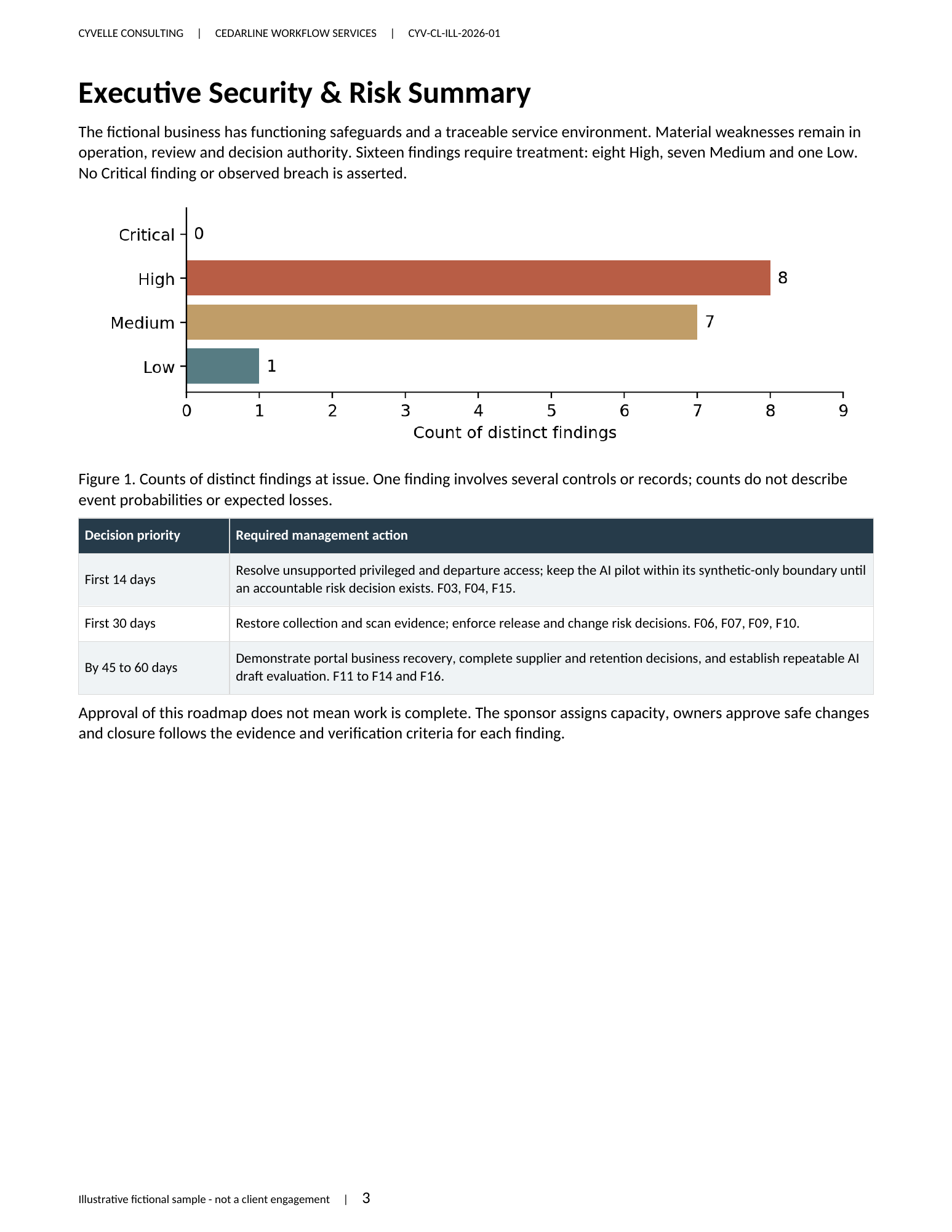
| Executive summary/readout | Material themes, trade-offs and required decisions | How to allocate resources and track progress |
12
A score needs an explanation
| Evidence state | Treatment |
|---|---|
| Documented process with operating records | Evaluate against the defined criteria and retain references |
| Process described but supporting records unavailable | Record an evidence limitation; do not equate assertion with demonstrated operation |
| Control gap confirmed through review | Identify its consequence, owner and closure evidence |
| Area outside scope | Identify the exclusion; do not include it in a completeness claim |
The report explains the denominator for any scored view and avoids presenting a score as a breach probability or guaranteed risk reduction.
13
How the work runs
Choose the business purpose and criteria. Gather scoped documents and interview owners. Review records and walkthroughs. Calibrate findings using the documented method. Present priorities and constraints to leadership. An improvement roadmap is proposed work, not completed remediation.
14
Build a roadmap with verifiable milestones
Organize the proposed work around urgency, dependency and available capacity. Near-term actions address decisions or gaps that cannot reasonably wait. Foundation work establishes repeatable ownership and operating records. Later improvement checks whether those practices remain effective as the business changes.
| For each proposed action | Record in the roadmap |
|---|---|
| Priority | Business consequence, urgency and the reason for the sequence |
| Ownership | Accountable owner, delivery team and required management decision |
| Dependency | Budget, access, supplier input or preceding work |
| Milestone | An agreed target date and observable acceptance condition |
| Closure | The evidence a reviewer needs to confirm the action is complete |
Dates and review intervals are agreed for the engagement. A phased roadmap does not promise that every gap can be resolved in one year or that we have implemented the changes.
15
Give each audience the evidence it needs
The leadership readout explains the material themes, uncertainties and decisions requiring resources. The working findings retain the criteria, evidence references, owners and proposed closure conditions needed by the team responsible for improvement. Agree the audience and permitted use before sharing sensitive findings outside the organization.
See the Sample Assessment Report → A sample illustrates presentation; the engagement proposal defines the actual assessment method, scope and deliverables.
16
Maturity assessment or Governance Blueprint?
Choose a maturity assessment when you need consistent program baselining against defined criteria. Choose the Governance Blueprint when the immediate goal is an integrated view of security, governance and compliance gaps with prioritized findings. The initial call determines whether one scope answers both needs without duplicating evidence requests.
17
Assessment questions
Does the score prove compliance?
No. A maturity profile evaluates the scoped program using defined criteria. A legal compliance or independent assurance conclusion requires its own process.
Is this a penetration test?
No. Technical exploitation testing is separately authorized and scoped. Existing test reports inform the evidence review where relevant.
Will we receive a roadmap our team has capacity to execute?
The proposed roadmap records resources, dependencies and sequencing. Management approves priorities and funds execution.
How much does it cost and how long does it take?
The written proposal confirms scope, fee and schedule after domain and evidence requirements are understood.
18
Planning and using the assessment
How does this differ from an audit?
The assessment explains the maturity demonstrated against agreed criteria and identifies improvement priorities. An audit may have a different purpose, evidence standard and assurance process. Agree the decision you need before selecting the engagement.
When should the baseline be revisited?
Agree a review interval with the program owner and revisit the scope after material business, technology or responsibility changes. Use consistent criteria where comparison is useful and explain changes to the method or evidence boundary.
Does the assessment issue a CMMC result or SPRS score?
A general maturity profile does not establish either result. If defense-contract requirements are relevant, identify them during scoping and agree the applicable readiness work, assessment method and any separate submission responsibility.
Can the report answer buyer questionnaires?
The findings can help your team locate relevant evidence and explain current limitations. Each answer still needs to match the buyer's question, the current state and the information you are authorized to share. Procurement outcomes and completion of other assurance processes remain outside the report's control.
19
Establish the baseline behind the next budget decision
Bring your program priorities, current assessments and available owners. We will discuss the evidence needed for a useful baseline.
Free 30-minute cybersecurity maturity strategy call. No obligation.
21
Scope and fee
Fixed fee confirmed after scoping.